
Kiriburu and Meghahatuburu are twin mining towns and hill destinations in West Singhbhum, Jharkhand, in the Saranda forest region. They lie close to the Odisha border. Surrounded by forested hills, mining landscapes, and spectacular viewpoints, the twin destinations offer a very different experience from the more commercial hill stations of eastern India.
Kiriburu is closely associated with the Kiriburu Iron Ore Mine, while Meghahatuburu is home to the Meghahatuburu Iron Ore Mine, both operated by the Steel Authority of India Limited (SAIL). But the appeal of these hill towns extends beyond mining. The surrounding forests, hills, viewpoints, waterfalls and quiet roads make Kiriburu-Meghahatuburu an interesting destination for travelers looking for a less commercial hill experience.
I visited Kiriburu-Meghahatuburu during the monsoon and found the landscape particularly atmospheric at that time. Clouds, rain, mist, red earth, forests, and waterfalls - together they transformed the journey into an experience quite different from a conventional sightseeing trip.
Last updated: October 4, 2026
Published on: February 2, 2023

| Kiriburu-Meghahatuburu at a Glance | |
|---|---|
| Location | West Singhbhum, Jharkhand, close to the Odisha border |
| Region | Saranda forest region |
| Known for | Forests, hills, viewpoints, waterfalls and iron-ore mining |
| Nearest major railway options | Barajamda and Barbil are useful railway access points; check current train schedules and onward road transport before traveling. |
| Major nearby towns and cities | Jamshedpur, Chaibasa, Barbil, Rourkela, and Keonjhar |
| Best for | Nature, photography, waterfalls, viewpoints and offbeat travel |
| Best season | Depends on your purpose; monsoon offers lush scenery and waterfalls, while drier months can provide easier road and trail conditions |
| Suggested duration | 2 nights / 3 days |
| Accommodation | Limited; check availability before traveling |
| Important consideration | Some mining and forest areas may have access restrictions |
During my visit, we traveled from Howrah towards Barbil by train on a monsoon morning. Barbil was our railhead for the onward road journey to Kiriburu-Meghahatuburu.

After the train reached Barbil station, we boarded the car sent by our tour operation from just outside the station to start our journey towards Kiriburu.
How to Reach Kiriburu-Meghahatuburu
Kiriburu-Meghahatuburu can be reached by road from several towns in Jharkhand and northern Odisha. The most convenient route for you will depend on your starting point.
By Train
Barajamda is one of the nearest railway stations for reaching Kiriburu-Meghahatuburu, while Barbil is another useful railhead, particularly for travelers approaching from the Odisha side. Jharkhand Tourism also notes road connectivity from Barajamda and Barbil towards Kiriburu-Meghahatuburu. Check the current railway timetable and arrange onward road transport before traveling.
If you are traveling from Kolkata, check the current railway timetable before booking, because train schedules and operating days can change.
By Road
Kiriburu and Meghahatuburu are connected by road with the surrounding towns of Jharkhand and Odisha. Road connectivity exists from Tatanagar/Jamshedpur and there are routes through the West Singhbhum region.
For a road trip, check the current road condition before starting the journey, particularly during the monsoon.
From Barbil
One practical option is to reach Barbil by train and arrange a car or local transport for the onward journey.
This was the option I used during my trip. A car was waiting for us outside Barbil station and took us towards Kiriburu. My experience was based on the travel arrangements available at the time of my visit, so travelers should confirm current taxi availability and fares before traveling.
Important
Do not rely on old train timings, taxi fares or package prices mentioned in older travel blogs. Check the current railway timetable and local transport availability before your trip.
Best Time to Visit Kiriburu-Meghahatuburu
The best time to visit Kiriburu and Meghahatuburu depends on the type of experience you want.
Monsoon - July to September
I visited Kiriburu-Meghahatuburu during the monsoon and was struck by how dramatically the clouds and rain transformed the landscape. The hills became greener, mist frequently covered the higher areas, and waterfalls and streams were more active. However, heavy rain can make forest roads, trails and waterfall approaches slippery and difficult.
Winter - October to February
The cooler months generally offer more comfortable conditions for sightseeing, road travel, and outdoor exploration. Clearer weather can also make the viewpoints more rewarding.
Summer - March to June
Summer can be warmer, but the forested landscape still makes the area suitable for travelers who prefer quieter trips. If you plan outdoor sightseeing, start early and check local conditions before heading out.
Before travelling to Kiriburu-Meghahatuburu, check the latest weather and road conditions, particularly if you plan to visit waterfalls or take forest routes.
My recommendation based on experience: If your priority is lush greenery, mist, and waterfalls, the monsoon can be particularly atmospheric. If easier road travel and outdoor exploration are more important, the drier months may be more convenient.
Day 1: Arriving in Kiriburu and Exploring the Surroundings
After reaching the Kiriburu Hilltop Guest House, we freshened up. The dining hall at the Kiriburu Hilltop Guest House is a large one. We had lunch at the guest house before starting our sightseeing. During my stay, meals included rice, dal, vegetables, salad and fish curry. Once the lunch was over, we got into the car and headed toward the Bolani Ores Mines.

The surrounding hills, forest roads, mining landscape and changing monsoon weather also make the area interesting for photography. During my visit, I found several viewpoints and roadside landscapes worth stopping for.
Bolani Ores Mines: A Mining Landscape Along the Journey
The mining landscape is an important part of the character of the Kiriburu-Meghahatuburu region. During my visit, we traveled towards the Bolani Ores Mines and viewed the mining area from outside rather than entering the operational mine.
The red earth, forested hills and mining landscape create a striking contrast, particularly during cloudy or rainy weather.

What's the color of the soil that you're accustomed to seeing?
The soil around the mining landscape appeared distinctly reddish during our visit. The colour, combined with the forested hills and mining activity, created a striking landscape. We could see the mine from which the ores are extracted. In fact, the large trucks, which were carrying the fresh ores out of the iron mine seemed like giants coming out of underground caves.
Important: Bolani is a working mining area. Do not enter restricted or operational areas without explicit permission from the responsible authorities. Follow all signs, security instructions, and local safety requirements. If access is restricted on the day of your visit, enjoy the landscape from permitted public areas instead.
SAIL's current information continues to list Bolani Ores Mines among its mining operations.

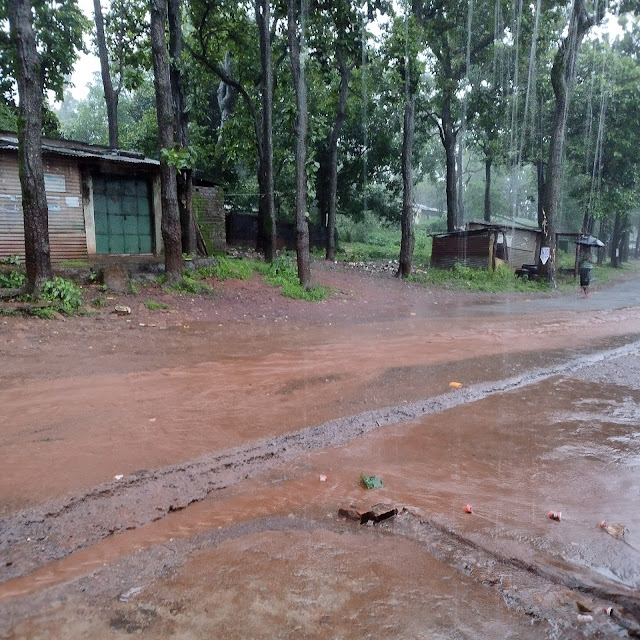
During our visit, some of the water and wet soil around the mining landscape appeared distinctly reddish. The red earth, cloudy sky and surrounding forest created a striking contrast with the mining landscape.

From the Bolani Mines, we headed toward the Kiriburu Sunset View Point near Meghahatuburu.
Kiriburu-Meghahatuburu Viewpoints and Sunset
The sunset viewpoint is one of the places travelers can visit for views across the surrounding hills and forests.
After getting down from the car, we walked a little uphill through the overgrown shrubs to reach the Kiriburu Sunset View Point. The viewpoint has railings along the edge of the gorge, and the surrounding hills and clouds create an impressive landscape, particularly during the monsoon. Take a look and you can see the clouds roaming around there just as cattle grazing in a field.
Travel tip: Sunset times vary throughout the year. Reach the viewpoint with enough daylight remaining, and avoid returning through unfamiliar forest roads after dark, unless you are traveling with a local driver who knows the route. Viewpoint access can depend on local conditions and restrictions, so confirm the route with your accommodation provider or local driver before setting out.

After witnessing the amazing sunset, we went to the main marketplace of Kiriburu. It is small and relatively modest market, with just a few local shops and eateries. However, the coffee that we had at a restaurant there was amazing and perfect to give us some warmth in that ambiance. Besides, the rains, the fog, the clouds, the light from the street lamps, and the darkness had created a magical atmosphere at that seemingly mundane place.

Day 2: Kundul Forest and Jhinkra Waterfall
We started early the next day, going to the local forest called Kundul. Staying in the cities, we hardly get a chance to come so close to nature. The road into the forest was made of red soil and gravel and passed between the trees.

During my visit, our driver took us into the forest and we stopped at a suitable location before walking around the area. Access to forest roads can depend on local conditions and permissions, so check locally before entering.

After spending some time in the Kundul Forest, we headed toward a popular waterfall - the Jhinkra waterfall.
Jhinkra Waterfall
Safety note: Forest and waterfall routes can become slippery and difficult during heavy rain. Wear suitable footwear, avoid walking close to unstable edges, and do not enter fast-flowing water. Conditions can change quickly during the monsoon.
The road to Jhinkra Waterfall passes through forests and open fields. And if you look closely, you might find a few huts with thatched roofs here and there on those fields. We even crossed a stream during the journey. During our visit, the water appeared reddish against the surrounding landscape.

After a while, the road isn't that great. That's because we had entered a dense forest. So, we got down from our car and started walking. Our driver became our guide. He took us through narrow roads with forests on both sides. Soon those roads disappeared and we started walking through a field. And as that field ended, we started walking up a mountain. From far away, we could see the waterfall as a small thread of water flowing down the body of the mountain. We stepped on boulders and crossed a few streams and rivulets.
This little trek seemed to make sense when we reached the spot just below the waterfall. The view was amazing!

The water was flowing down from quite a height and appeared reddish as it cascaded down the rocks. It sprinkled anyone who came close to the bottom of the cascade of waters.

The water, with a touch of sunrays, formed a magical rainbow right at the bottom of the waterfall.
Visiting the Jhinkra Waterfall
The approach to the waterfall can involve walking over uneven terrain, streams, and rocks, particularly when traveling during the monsoon.
Before setting out:
- Wear shoes with a good grip.
- Carry drinking water.
- Keep your phone and camera protected from rain.
- Avoid visiting alone.
- Follow local instructions about forest access.
- Do not enter the water if the current is strong.
- Avoid the area during dangerous weather conditions.
Because road and trail conditions can change, ask your local driver or accommodation provider about the current route before leaving.
Back to Kiriburu Hilltop Guest House
By the time we came down from the waterfall to our car, it had started raining heavily. We moved across drenched roads through the forests that added to the sense of adventure.

When we reached Kiriburu Hilltop Guesthouse, the surroundings were covered with dense cloud. The place seemed to live up to its name of Meghahatuburu - the abode of clouds.

By evening, dense clouds had covered the area and the surroundings became extremely dark. The combination of mist, trees and the few distant lights created a memorable atmosphere around the guest house. The little bit of light coming from some faraway place, together with the trees and the clouds, formed a magical ambiance at the Kiriburu Hilltop Guest House.
.jpg "Magical Kiriburu Hilltop Guest House")
Day 3: Murga Mahadev Temple and Return Journey
The next morning, we had a train to catch. And we had another destination on our list before we board the train - the Murga Mahadev Temple at Noamundi.
Murga Mahadev Temple and Waterfall near Noamundi
Our final sightseeing stop was Murga Mahadev Temple and Waterfall near Noamundi.
We started early from Kiriburu. The shrine is dedicated to Lord Shiva, and the waterfall beside the temple makes the site an interesting stop for travelers combining a temple visit with a nature outing.
We visited the temple before continuing towards the railway station for our return journey.
If you plan to visit, check the current local road conditions and any temple-specific arrangements before traveling, particularly during festivals and the monsoon.

We had our lunch at a restaurant near the station. Instead of going to the Barbil station, we went to the Bara Jamda Railway Station and boarded the train for Howrah from there, bringing an end to our short but amazing Kiriburu Meghahatuburu trip.
Where to Stay in Kiriburu-Meghahatuburu
Accommodation in Kiriburu-Meghahatuburu is more limited than in established tourist destinations. So, it is advisable to arrange your stay before traveling.
Kiriburu Hilltop Guest House
During my trip, I stayed at the Kiriburu Hilltop Guest House. The accommodation was modest, but its hilltop location and surrounding landscape were major advantages.
As you enter the one-storied Kiriburu Hilltop Guest House, there’s a long verandah that runs from one end of the building to the other. Along this verandah are a few rooms and a kitchen-cum-dining hall. The room that we had booked seemed to be quite modest. It had a bed, a couple of chairs, a small table, and an almirah. There was an attached washroom with basic toiletries.
The rooms and facilities I experienced were basic rather than luxurious. Food was also available at the property during my stay.
Important: My description reflects the condition and facilities I experienced during my visit. Accommodation facilities, availability, tariffs, and booking procedures can change. Confirm the current status directly before traveling.
Other accommodation options may be available in and around Kiriburu, Meghahatuburu, Barbil and Noamundi. Availability, tariffs, facilities and booking arrangements can change, so confirm current options before traveling.
Things to Do in Kiriburu-Meghahatuburu
There are quite a few things that you can do during your visit to Kiriburu-Meghahatuburu. Depending on current local access and weather conditions, a trip can include:
- Enjoying the hill and forest scenery
- Visiting permitted viewpoints
- Photographing the monsoon landscape
- Exploring the local marketplace
- Visiting permitted waterfall areas
- Visiting the Meghahatuburu viewpoint and surrounding hills
- Enjoying views of the Saranda forest and surrounding hill ranges
- Visiting Murga Mahadev Temple and Waterfall near Noamundi
- Experiencing the changing landscape of the Saranda region
Mining and forest areas may have access restrictions. Always follow local instructions and avoid entering restricted areas.
If you are interested in exploring more destinations in Jharkhand, you can also read our Jharkhand road trip guide covering Netarhat, Maromar, Betla and McCluskieganj.
How Many Days Are Enough for Kiriburu-Meghahatuburu?
For a first visit, 2 nights and 3 days is a practical duration for Kiriburu-Meghahatuburu.
A three-day trip gives you enough time to:
- Arrive and settle in
- Explore Kiriburu and Meghahatuburu
- Visit viewpoints
- Explore permitted forest and waterfall areas
- Visit Murga Mahadev
- Travel back without making the trip unnecessarily rushed
If you are traveling specifically for photography or monsoon landscapes, you may prefer a slower itinerary.
Suggested 3-Day Kiriburu-Meghahatuburu Itinerary
Day 1 — Arrival and Kiriburu
- Arrive at Barajamda, Barbil or another suitable rail/road access point, depending on your route.
- Travel to Kiriburu-Meghahatuburu by car.
- Check in to your accommodation.
- Have lunch and rest.
- Explore permitted nearby areas.
- Visit a viewpoint around sunset.
- Return to your accommodation before it's dark.
Day 2 — Forests and Waterfalls
- Start early.
- Visit permitted forest areas.
- Explore Jhinkra Waterfall, if local conditions and access permit.
- Return to your accommodation.
- Spend the evening exploring the hill town and surroundings.
Day 3 — Murga Mahadev and Return
- Check out after breakfast.
- Visit Murga Mahadev Temple and Waterfall near Noamundi, if it fits your route.
- Continue towards your railway station or onward destination.
- Confirm your train or road connection in advance.
Kiriburu-Meghahatuburu Trip Cost
The cost of a Kiriburu-Meghahatuburu trip depends heavily on your starting point, transport, accommodation, number of travelers, and whether you hire a private vehicle.
Your major expenses are likely to include:
- Train or bus fare
- Local/private vehicle
- Accommodation
- Food
- Local sightseeing
- Entry or permission charges, wherever applicable
Check current transport, accommodation, and vehicle rates before planning your budget.
Where to Eat in Kiriburu-Meghahatuburu
Dining options are mostly limited in Kiriburu-Meghahatuburu. You are likely to get modest but delectable food at the place where you're staying. While I stayed at Kiriburu Hilltop Guest House, I was served rice, dal, vegetables, salad and fish curry for lunch.
What to Pack for Your Kiriburu-Meghahatuburu Trip
Things you need to pack for your Kiriburu-Meghahatuburu trip depends on the time when you're visiting. It varies significantly from one season to another. Some of the most important things that should be part of your Kiriburu-Meghahatuburu packing list are:
- Comfortable walking shoes
- Rain jacket and umbrella during monsoon
- Water bottle
- Power bank
- Basic medicines
- Torch
- Mosquito protection
- Waterproof phone/camera protection
- Light warm clothing for cooler months
- A small backpack
Frequently Asked Questions
Is Kiriburu-Meghahatuburu worth visiting?
Kiriburu-Meghahatuburu is a good fit for travelers who enjoy forests, hills, viewpoints, waterfalls and quieter destinations. My monsoon visit was particularly memorable for the mist, greenery and waterfalls. Travelers looking for nightlife, extensive shopping or a highly developed tourist infrastructure may find the destination limited.
What is Kiriburu famous for?
Kiriburu is known for its forested hill landscape and its association with iron-ore mining. It is located in the Saranda region of West Singhbhum.
What is Meghahatuburu famous for?
Meghahatuburu is known for its hilltop location, forest scenery, viewpoints and connection with the SAIL mining area.
Is Kiriburu suitable for a family trip?
It can be suitable for families who enjoy nature and quiet destinations, but some sightseeing locations involve uneven roads, walking and outdoor terrain. Families should choose attractions according to weather and current access conditions.
Is Kiriburu suitable for a monsoon trip?
The monsoon can produce dramatic scenery, mist and flowing waterfalls, but heavy rain can also make roads and trails slippery. Check weather and local conditions before traveling.
How many days are enough?
Two nights and three days is a practical starting point for a first visit.
Is accommodation easily available?
Accommodation is more limited than in mainstream tourist destinations. Booking in advance is advisable.
Can tourists enter the mines?
Do not assume that core mining areas are open to tourists. Operational and restricted areas should only be entered with explicit permission from the responsible authorities.